We welcome article submissions from experts in the areas of coal, mining,
shipping, etc.
To Submit your article please click here.
|
|
|
Friday, 05 June 20
U.S. SANCTIONS COMPLIANCE GUIDANCE RELEASED FOR THE GLOBAL MARITIME, ENERGY AND METALS SECTORS - AKIN GUMP
 Key Points Key Points
-
On May 14, 2020, OFAC, the Department of State and the U.S. Coast Guard jointly released guidance for persons involved in the maritime industry regarding common deceptive shipping practices used to subvert U.S. and United Nations sanctions programs targeting Iran, North Korea and Syria.
-
The guidance highlights certain deceptive practices employed in maritime activity that could signal sanctions evasion.
-
The guidance also contains specific measures that the maritime industry and energy and metals sectors can take to tailor their sanctions compliance programs to avoid sanctions violations or otherwise supporting illicit shipping activities.
-
This Guidance is part of a sustained focus on the international shipping industry, including the U.S. Government’s latest enforcement actions in the shipping sector on June 2, 2020.
The Guidance
On May 14, 2020, the Department of the Treasury’s Office of Foreign Assets Control (OFAC), the Department of State and the U.S. Coast Guard jointly released guidance (the “Guidance”) regarding common deceptive shipping practices in order to aid persons involved in the maritime industry, and energy and metals sectors, in tailoring their due diligence and sanctions compliance policies and procedures. The Guidance is particularly targeted towards ship owners, managers, operators, brokers, ship chandlers, flag registries, port operators, shipping companies, freight forwarders, classification service providers, commodity traders, insurance companies and financial institutions. The shipping industry continues to present particularly challenging issues associated with U.S. sanctions compliance, including the involvement of numerous parties in particular voyages all with different, yet overlapping risks.
The Guidance continues a further and concerted effort by OFAC to focus in particular on the shipping industry and builds on prior advisories that it has issued directed at the shipping industry, including one issued on September 4, 2019, entitled “Sanctions Risks Related to Shipping Petroleum and Petroleum Products from Iran” that also identified specific deceptive shipping practices and risk mitigation measures for the industry. As the U.S. Government’s latest enforcement actions on June 2, 2020 demonstrate, OFAC sanctions enforcement attention is squarely focused on the international shipping industry.
The Guidance also provides important insights for companies operating in the maritime sector regarding the criteria that OFAC applies when evaluating an effective sanctions compliance program for such companies.
Below we summarize key points from the Guidance that are relevant for the shipping sector, including a summary of deceptive practices highlighted in the Guidance, a summary of general practices for effective identification of potential sanctions evasion and summaries of guidance for certain actors in the maritime industry and country-specific guidance.
Deceptive Shipping Practices
The Guidance provides a summary of common tactics utilized to facilitate sanctionable or illicit maritime trade linked to Iran, North Korea and Syria, including:
-
Disabling or manipulating the Automatic Identification System (AIS) on vessels to conceal a vessel’s port of call or other information regarding its voyage.
-
Physically altering vessel identification to obscure the identities of sanctioned vessels or vessels engaging in sanctionable activities.
-
Falsifying cargo and vessel documents, particularly with respect to shipments involving petrochemicals, petroleum, petroleum products, metals (steel, iron) or sand to disguise their origin.
-
Ship-to-Ship (STS) Transfers used to conceal origin/destination of products.
-
Voyage irregularities to disguise the ultimate destination or origin of cargo, including indirect routing, unscheduled detours or transit or transshipment of cargo through third countries.
-
False flags and flag hopping (i.e., repeatedly registering vessels with new flag states).
-
Use of complex ownership or management to disguise the ultimate beneficial owner of cargo or commodities in order to avoid sanctions or other enforcement actions.
General Practices for Effective Identification of Sanctions Evasion
The Guidance also highlights, and provides details regarding, the following practices for effective identification of potential sanctions evasion:
-
Institutionalizing a sanctions compliance program, including through the implementation of written standardized operational compliance policies, procedures, standards of conduct and safeguards.
-
Establishing AIS best practices and contractual requirements that make disabling/manipulating AIS for illegitimate reasons grounds for termination of contracts or investigations.
-
Monitoring ships throughout the entire transaction lifecycle, including through supplementing AIS with Long Range Identification and Tracking (LRIT) and receiving periodic LRIT signals on a frequency informed by the entity’s risk assessment.
-
Conducting “Know Your Customer” due diligence on customers and counterparties, which could include “maintaining the names, passport ID numbers, address(es), phone number(s), email address(es), and copies of photo identification of each customer’s beneficial owner(s).”
-
Exercising supply chain due diligence, including, as appropriate, conducting due diligence to ensure that recipients and counterparties to a transaction are not sending or receiving commodities that may trigger sanctions, such as Iranian petroleum or North Korea-origin coal, and implementing controls that allow for verification-of-origin and recipient checks for ships that conduct STS transfers.
-
Incorporating the above “best practices” into contracts.
-
Sharing information about sanctions evasion techniques and threats amongst industry groups.
Annex A: Actor-specific Guidance
In Annex A, the Guidance provides bulleted lists of guidance and information for particular actors within the maritime industry, including: maritime insurance companies, flag registry managers, port state control authorities, shipping industry associations, regional and global commodity trading, supplier, and brokering companies, financial institutions, ship owners, operators, and charterers, classification societies, vessel captains and crewing companies.
Below we summarize the guidance with respect to ship owners, operators and charterers, vessel captains and crewing companies.
Ship Owners, Operators, and Charterers:
-
Identify vessels that, in the past two years, have a pattern of AIS manipulation not consistent with the International Convention for the Safety of Life at Sea and terminating business relationships with clients that continue to use those vessels.
-
Keep and analyze records, including, where possible, photographs, of delivery and recipient vessels and/or recipients located at ports when possible, to enhance end-use verification.
-
Protect employees who reveal illegal or sanctionable behavior from retaliation.
-
Incorporate data into due diligence practices from organizations that provide commercial shipping data.
-
Communicate to counterparts as necessary and appropriate (e.g., ship owners, managers, charterers, operators) an expectation that they have adequate and appropriate compliance policies.
Vessel Captains:
-
Ensure deck officers are aware of the International Maritime Organization’s (IMO) AIS regulations, including the requirement to consistently broadcast AIS transmissions.
-
Communicate to ship owners and charterers that vessels are monitored for AIS disablement and that any occurrences of AIS disablement will be investigated.
-
Understand vessels’ AIS history to determine whether they may have been involved in illicit activities.
-
Before engaging in ship-to-ship transfers, verify the other vessel’s name, IMO number and flag, and ensure there is a legitimate business purpose for the transfer.
Crewing Companies:
-
Ensure crewmembers are aware of IMO guidance in relation to illicit shipping and the reasons why certain practices are unsafe.
-
Communicate to clients that crews are monitored for AIS disablement and that any occurrences of AIS disablement will be investigated.
-
Understand vessels’ AIS history to determine whether it may have been involved in illicit activities.
-
Ensure that crewmembers who reveal illegal or sanctionable activity are protected from retaliation and providing a confidential mechanism for reporting sanctionable conduct.
Annex B: Country Guidance
In Annex B, the Guidance summarizes relevant provisions of U.S. and U.N. sanctions programs concerning North Korea, Iran and Syria and actions prohibited under said programs relevant to the maritime industry. It also highlights a few points with respect to recent deceptive practices to facilitate illicit shipping to North Korea, Syria, and Iran which are summarized below.
North Korea:
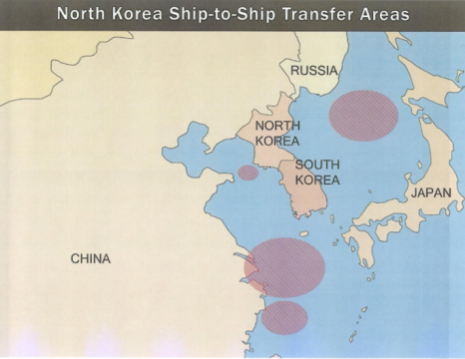
North Korea reportedly exported 3.7 million metric tons of coal between January and August 2019, in violation of U.N. sanctions. Further, while under United Nations Security Council Resolution 2397, North Korea is limited to importing a maximum of 500,000 barrels of petroleum per year, from January to October 2019. North Korea ports received 221 tanker deliveries, which, if fully laden, would result in approximately 3.89 million barrels of imports. According to the Guidance, these illicit exports and imports are primarily effectuated via ship-to-ship transfers in Chinese territorial seas. Image 1 below depicts the most common areas in which such ship-to-ship transfers take place.
|
|
Common Locations of Ship-to-Ship Transfers subverting North Korean Sanctions1 |
North Korea is also reportedly acquiring vessels destined for scrapping and non-ocean-going barges that do not transmit AIS signals to engage in illicit import/export operations.
Syria:
The Guidance notes that “the supply chain and petroleum-related shipments [to Syria] create significant sanctions risk for those in the maritime industry.” As an example, it highlights the September 2019 OFAC action against Maritime Assistance LLC for facilitating the sale and delivery of jet fuel to Russian military forces operating in Syria. It also highlights the OFAC action in the November 2018 scheme in which Iranian and Russian entities engaged in a payment offsetting arrangement in which the sale and shipment of Iranian oil to Syria provided funding to Iran and proxy groups such as Hizballah, the Islamic Resistance Movement (HAMAS) and the Islamic Revolutionary Guard Corps-Quds Force (IRGC-QF).
Iran:
The Guidance did not provide specific guidance with respect to deceptive shipping practices used to subvert Iran-related sanctions—rather, it noted that the IRGC-QF continues to try to evade U.S. sanctions “by obfuscating the origin, destination, and recipient of oil shipments,” stating that “the use of such deceptive tactics is unique neither to Iran nor to Iran’s petroleum industry.”
Companies in the shipping industry or whose businesses intersect the shipping sector should assess their sanctions risk in light of this latest U.S. government guidance and make necessary modifications or enhancements to their compliance programs to mitigate this risk.
Source: Akin Gump, Strauss Hauer & Feld LLP
If you believe an article violates your rights or the rights of others, please contact us.
|
|
Friday, 05 January 24
BANGLADESH’S 2023 COAL-FIRED POWER OUTPUT TRIPLED, EASING SHORTAGES - REUTERS
Bangladesh nearly tripled its coal-fired power output in 2023, a Reuters analysis of government data showed, helping it tide over the worst power s ...
Tuesday, 02 January 24
COAL TRADE CONTINUES TO HEAD EAST - BALTIC EXCHANGE
The global coal trade, once concentrated in the Pacific and Atlantic basins, is undergoing a significant transformation, as highlighted in the Inte ...
Tuesday, 02 January 24
COAL CARGOES: AVOIDING EXPLOSION AND SELF-HEATING - GARD
KNOWLEDGE TO ELEVATE
Despite its contribution to greenhouse gas emissions, global coal consumption climbed to an all-time high in 2022 and is ...
Tuesday, 02 January 24
SINOPEC FORECASTS CHINA’S COAL CONSUMPTION TO PEAK AROUND 2025 - REUTERS
China Petrochemical Corp, or Sinopec, expects coal consumption to peak around 2025 at 4.37 billion metric tons, the state energy group said in an o ...
Thursday, 07 December 23
CHINA TO SET UP COAL PRODUCTION RESERVE TO STABILISE PRICES - REUTERS
China will establish a back-up coal production system by 2027 to stabilise prices and secure coal supply, the state planner said on Wednesday, even ...
|
|
|
Showing 61 to 65 news of total 6871 |
|
 |
|
|
|
|
| |
|
 |
|
|
| |
|
- Bhoruka Overseas - Indonesia
- Metalloyd Limited - United Kingdom
- Ministry of Finance - Indonesia
- Pendopo Energi Batubara - Indonesia
- TNB Fuel Sdn Bhd - Malaysia
- Bhushan Steel Limited - India
- Independent Power Producers Association of India
- Renaissance Capital - South Africa
- Sinarmas Energy and Mining - Indonesia
- Binh Thuan Hamico - Vietnam
- Energy Development Corp, Philippines
- Attock Cement Pakistan Limited
- Indian Energy Exchange, India
- LBH Netherlands Bv - Netherlands
- Rashtriya Ispat Nigam Limited - India
- IHS Mccloskey Coal Group - USA
- India Bulls Power Limited - India
- Wood Mackenzie - Singapore
- AsiaOL BioFuels Corp., Philippines
- SN Aboitiz Power Inc, Philippines
- Directorate Of Revenue Intelligence - India
- Power Finance Corporation Ltd., India
- ICICI Bank Limited - India
- Billiton Holdings Pty Ltd - Australia
- Aditya Birla Group - India
- The State Trading Corporation of India Ltd
- Thai Mozambique Logistica
- Indian Oil Corporation Limited
- Vijayanagar Sugar Pvt Ltd - India
- Lanco Infratech Ltd - India
- Essar Steel Hazira Ltd - India
- Kumho Petrochemical, South Korea
- Karbindo Abesyapradhi - Indoneisa
- Offshore Bulk Terminal Pte Ltd, Singapore
- Ministry of Transport, Egypt
- Gujarat Mineral Development Corp Ltd - India
- Coal and Oil Company - UAE
- TeaM Sual Corporation - Philippines
- Formosa Plastics Group - Taiwan
- Indika Energy - Indonesia
- GN Power Mariveles Coal Plant, Philippines
- Marubeni Corporation - India
- Central Java Power - Indonesia
- Dr Ramakrishna Prasad Power Pvt Ltd - India
- Mjunction Services Limited - India
- Trasteel International SA, Italy
- Filglen & Citicon Mining (HK) Ltd - Hong Kong
- Bukit Asam (Persero) Tbk - Indonesia
- Baramulti Group, Indonesia
- Merrill Lynch Commodities Europe
- Mintek Dendrill Indonesia
- Sindya Power Generating Company Private Ltd
- Kepco SPC Power Corporation, Philippines
- Petron Corporation, Philippines
- Therma Luzon, Inc, Philippines
- Larsen & Toubro Limited - India
- Kalimantan Lumbung Energi - Indonesia
- Cement Manufacturers Association - India
- South Luzon Thermal Energy Corporation
- Gujarat Electricity Regulatory Commission - India
- Indogreen Group - Indonesia
- Petrochimia International Co. Ltd.- Taiwan
- Anglo American - United Kingdom
- Dalmia Cement Bharat India
- Madhucon Powers Ltd - India
- Bharathi Cement Corporation - India
- Karaikal Port Pvt Ltd - India
- European Bulk Services B.V. - Netherlands
- Borneo Indobara - Indonesia
- Posco Energy - South Korea
- Vedanta Resources Plc - India
- Leighton Contractors Pty Ltd - Australia
- Jaiprakash Power Ventures ltd
- Ambuja Cements Ltd - India
- Salva Resources Pvt Ltd - India
- Coastal Gujarat Power Limited - India
- OPG Power Generation Pvt Ltd - India
- Alfred C Toepfer International GmbH - Germany
- Antam Resourcindo - Indonesia
- Truba Alam Manunggal Engineering.Tbk - Indonesia
- GMR Energy Limited - India
- Bahari Cakrawala Sebuku - Indonesia
- GVK Power & Infra Limited - India
- Ind-Barath Power Infra Limited - India
- Rio Tinto Coal - Australia
- Africa Commodities Group - South Africa
- Bangladesh Power Developement Board
- Gujarat Sidhee Cement - India
- Meralco Power Generation, Philippines
- Orica Mining Services - Indonesia
- Tamil Nadu electricity Board
- CNBM International Corporation - China
- Eastern Coal Council - USA
- SMC Global Power, Philippines
- Australian Commodity Traders Exchange
- Edison Trading Spa - Italy
- Jindal Steel & Power Ltd - India
- The Treasury - Australian Government
- Maheswari Brothers Coal Limited - India
- Pipit Mutiara Jaya. PT, Indonesia
- Chettinad Cement Corporation Ltd - India
- Asmin Koalindo Tuhup - Indonesia
- Miang Besar Coal Terminal - Indonesia
- Parliament of New Zealand
- Neyveli Lignite Corporation Ltd, - India
- Heidelberg Cement - Germany
- PetroVietnam Power Coal Import and Supply Company
- Simpson Spence & Young - Indonesia
- Bayan Resources Tbk. - Indonesia
- Kideco Jaya Agung - Indonesia
- Timah Investasi Mineral - Indoneisa
- GAC Shipping (India) Pvt Ltd
- Videocon Industries ltd - India
- Wilmar Investment Holdings
- Australian Coal Association
- Directorate General of MIneral and Coal - Indonesia
- Planning Commission, India
- Singapore Mercantile Exchange
- Banpu Public Company Limited - Thailand
- Electricity Generating Authority of Thailand
- Tata Chemicals Ltd - India
- Aboitiz Power Corporation - Philippines
- Sical Logistics Limited - India
- McConnell Dowell - Australia
- Chamber of Mines of South Africa
- Deloitte Consulting - India
- Indonesian Coal Mining Association
- Medco Energi Mining Internasional
- Makarim & Taira - Indonesia
- London Commodity Brokers - England
- White Energy Company Limited
- Kobexindo Tractors - Indoneisa
- Bulk Trading Sa - Switzerland
- Energy Link Ltd, New Zealand
- Riau Bara Harum - Indonesia
- PNOC Exploration Corporation - Philippines
- Indo Tambangraya Megah - Indonesia
- Semirara Mining Corp, Philippines
- Uttam Galva Steels Limited - India
- Orica Australia Pty. Ltd.
- Manunggal Multi Energi - Indonesia
- Coalindo Energy - Indonesia
- Star Paper Mills Limited - India
- Siam City Cement PLC, Thailand
- Oldendorff Carriers - Singapore
- Semirara Mining and Power Corporation, Philippines
- Sree Jayajothi Cements Limited - India
- Interocean Group of Companies - India
- Price Waterhouse Coopers - Russia
- Vizag Seaport Private Limited - India
- The University of Queensland
- San Jose City I Power Corp, Philippines
- Global Green Power PLC Corporation, Philippines
- Ceylon Electricity Board - Sri Lanka
- Carbofer General Trading SA - India
- Mercator Lines Limited - India
- Eastern Energy - Thailand
- Electricity Authority, New Zealand
- Grasim Industreis Ltd - India
- Malabar Cements Ltd - India
- Globalindo Alam Lestari - Indonesia
- Kapuas Tunggal Persada - Indonesia
- Commonwealth Bank - Australia
- Kartika Selabumi Mining - Indonesia
- Intertek Mineral Services - Indonesia
- Central Electricity Authority - India
- Savvy Resources Ltd - HongKong
- Meenaskhi Energy Private Limited - India
- Bukit Makmur.PT - Indonesia
- Sakthi Sugars Limited - India
- Iligan Light & Power Inc, Philippines
- New Zealand Coal & Carbon
- PowerSource Philippines DevCo
- Sarangani Energy Corporation, Philippines
- Toyota Tsusho Corporation, Japan
- Siam City Cement - Thailand
- PTC India Limited - India
- Economic Council, Georgia
- Bukit Baiduri Energy - Indonesia
- Jorong Barutama Greston.PT - Indonesia
- Dong Bac Coal Mineral Investment Coporation - Vietnam
- Barasentosa Lestari - Indonesia
- Global Coal Blending Company Limited - Australia
- Cigading International Bulk Terminal - Indonesia
- Latin American Coal - Colombia
- VISA Power Limited - India
- MS Steel International - UAE
- Standard Chartered Bank - UAE
- Holcim Trading Pte Ltd - Singapore
- Global Business Power Corporation, Philippines
- Mercuria Energy - Indonesia
- Kohat Cement Company Ltd. - Pakistan
- SMG Consultants - Indonesia
- Krishnapatnam Port Company Ltd. - India
- Minerals Council of Australia
- IEA Clean Coal Centre - UK
- Altura Mining Limited, Indonesia
- International Coal Ventures Pvt Ltd - India
- Sojitz Corporation - Japan
- Kaltim Prima Coal - Indonesia
- Agrawal Coal Company - India
- Goldman Sachs - Singapore
- CIMB Investment Bank - Malaysia
- Straits Asia Resources Limited - Singapore
- Bank of Tokyo Mitsubishi UFJ Ltd
- Georgia Ports Authority, United States
- Port Waratah Coal Services - Australia
- Ministry of Mines - Canada
- Thiess Contractors Indonesia
- Samtan Co., Ltd - South Korea
- Maharashtra Electricity Regulatory Commission - India
- Asia Pacific Energy Resources Ventures Inc, Philippines
- Romanian Commodities Exchange
- ASAPP Information Group - India
- Parry Sugars Refinery, India
- Bhatia International Limited - India
- Xindia Steels Limited - India
|
| |
| |
|


